
Discovery Church started in much the same way many people imagine a church plant beginning. We had a pastor, a core team, musicians, rented worship space, children’s ministry and the financial resources needed to bring everything together. That approach served us well and remains a valuable way to plant a church. At the same time, I am increasingly convinced that it is not the only way a new church can begin.
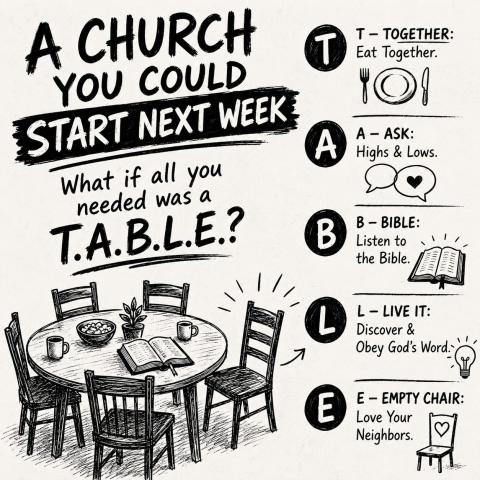
I recently read an article by Dave Ferguson, “A Church You Could Start Next Week.” I was struck by the simplicity of his approach. Ferguson calls it a T.A.B.L.E. Church. It can begin with a handful of people around one table in a home or with several groups meeting around multiple tables in a larger room. The model requires very little money, no building, and no large ministry team. It is also simple enough for an ordinary Christian to lead.
Ferguson organizes the gathering around five practices:
T — Together: Share a meal.
A — Ask: Talk about the highs and lows of life.
B — Bible: Listen to Scripture together.
L — Live It: Respond to God’s Word with obedience.
E — Empty Chair: Remember and love the neighbours who are not yet at the table.
I appreciate that the first two practices create space for relationships. Eating together changes the way people know one another. Asking about the highs and lows of the week gives people an opportunity to celebrate, name their struggles, and pray for one another. A church begins to take shape before anyone preaches a sermon.
The Bible practice especially caught my attention. I was introduced to the Public Reading of Scripture at the Multiply Conference in November 2025 by Scott Vander Ploeg, senior pastor of Sunlight Community Church, a CRC congregation in Port St. Lucie, Florida. During one of the sessions, we sat quietly while the words moved across a screen and a recorded voice read the text to us. I was amazed by how deeply engaged I became and by how quickly the time passed.
Scott also modelled this approach during Sunday worship as part of an experiment he was developing for church planting. Instead of centring the gathering on a sermon, the congregation listened to an extended reading of Scripture. A site pastor then facilitated a dialogue around the question, “What are we going to do about what we just heard?”
That experience showed me that listening to Scripture together can be both accessible and spiritually formative. It can also give a new church a Scripture-centred rhythm before it has a trained preacher.
The fourth practice, Live It, connects directly with the discipleship work I have been doing at Discovery. After hearing Scripture, Ferguson asks, “What are we going to do about what we just heard?” I was introduced to this discipleship method about twelve years ago and have used it at Discovery ever since. I have repeatedly asked people that same question and have seen incredible transformation in their lives.
Transformation happens when people hear God’s Word, agree to obey it and put it into practice. The goal is not simply to collect more biblical information. It is to help ordinary people listen to God and take their next faithful step.
The empty chair keeps the gathering from becoming an inward-looking circle. It represents the neighbour, friend or coworker who is not yet present. It reminds us to pray, listen, serve and make room for another person. When that chair is filled, we add another.
I can imagine this working alongside our exploration of house churches at Discovery. One table church could grow, several could begin in different homes, or multiple tables could eventually gather in one location. Over time, these gatherings could develop into a more traditional church plant and appoint a commissioned pastor.
What encourages me is that a commissioned pastor is not required before we begin. We can begin with hospitality, Scripture, obedience, mission and ordinary Christians willing to develop other leaders.
Ferguson does not claim that this answers every question about planting a church. Neither do I. But it gives us a practical place to begin. Perhaps church planting does not always need to start with finding significant funding, a facility and a pastor. Perhaps it can start with someone setting a table.

Let's Discuss
We love your comments! Thank you for helping us uphold the Community Guidelines to make this an encouraging and respectful community for everyone.