
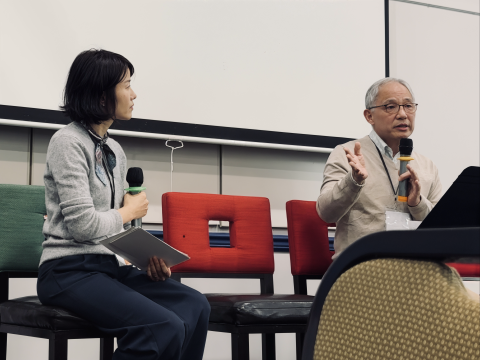
On April 21, during the "Dialogue with Denominational Leadership" session at the 40th Korean Ministry Association (KMA) Annual Gathering, Catheryn Jo, the Korean Connector and host of the session, invited Rev. MoonBae Kim onto the stage. His appearance brought a fresh wave of energy. While many attendees know Kim as the resident mood-maker and recreational leader of the KMA, fewer are aware of his quiet, invaluable leadership on the denomination’s foundational frontlines: the CRCNA Candidacy Committee.
As one of nine committee members tasked with overseeing ministerial examination and the vital gateway to ordination, Kim possesses a rare vantage point. He stands at the unique intersection of a first-generation Korean immigrant pastor, a dedicated scholar with three degrees from Calvin Theological Seminary, and a long-time peer to the Anglo leadership rooted in Grand Rapids.
The 30-minute interview conducted that day was an opportunity to share these rich insights. The following is a summary of the interview. We hope this serves as a valuable resource for reflecting on how the CRC, which is becoming increasingly multi-ethnic as it pursues diversity, can healthily embrace this diversity while ensuring that everyone experiences a true sense of belonging.
Q1. You have been part of the Grand Rapids North Classis for over 30 years. Are there still moments when you personally feel, "This Western denominational culture is still unfamiliar to me"?
Absolutely. It has been 36 years since I joined the CRC. I spent five grueling years earning my M.Div. at Calvin Theological Seminary, taking 214 credits, and I have been in sole pastoral ministry since 1995. Later, wanting to recharge, I spent another ten years at Calvin earning two Master of Theology (Th.M.) degrees.
Yet, despite 15 years of studying CRC theology and decades in ministry, I still frequently feel that the Western denominational culture is foreign.
Thirty-four years ago, Jul Medenblik (now president of Calvin Seminary) was my classmate and student body president while I was the editor-in-chief of Calvin Life. I asked him why the school wasn't granting certain requests made by the Korean Student Association. His response stayed with me forever. He said:
Jul: "MoonBae, it’s not that we don’t want to grant them; it’s simply very difficult for us to do so. The Korean students make requests based solely on their own immediate needs without knowing our context. They don't fully understand what kind of journey we have walked as a denomination and a seminary over the past 120 years (as of 1994), or how we faced and overcame various challenges and hardships to get where we are today. It takes a long history to explain why we don't just hire world-renowned scholars as professors, or why the seminary policy is set up the way it is. Rather than trying to understand that history of numerous trials and errors, Korean students tend to demand what they need right now. But MoonBae, if you make a proposal, we will listen. Because you have learned our history, you know how our theology has evolved, and you understand why we take our current stance."
This conversation became a constant reminder for me to look at things from the denomination's perspective throughout my ministry.
Like many other Korean pastors, I was raised and trained in the Presbyterian tradition. For a long time, these two pillars—Presbyterianism and Reformed theology—coexisted within me, bringing along a flurry of questions. However, no matter how much I asked and listened through a Presbyterian lens, there were many aspects of the CRC that I simply could not understand.
So, I made an intentional decision to fully step over to the Reformed pillar. For four years, I stopped questioning; instead, I simply immersed myself in what they taught, learning and embracing it fully. As I did, the answers to my old questions began to unfold naturally. At the same time, I began to clearly see both the strengths and weaknesses of Calvin Theological Seminary and our denomination.
I have lived in Korea for 24 years, in the United States for 40 years, and within the CRC for 36 years. Today, for the sake of pastoring a Korean immigrant church, I intentionally stand right in the middle—at the intersection of the Korean Presbyterian tradition and CRC Reformed theology—seeking to serve as a bridge between the two.
Therefore, I approach everything with caution. When I hear proposals or complaints from Korean churches, I often think, ‘Ah, the denominational structure makes this difficult to implement…’ On the other hand, when the denomination demands something from Korean churches, I find myself thinking, ‘Given the reality of immigrant churches, it is practically impossible to fulfill this completely.’ Standing on the borderline between these two worlds is by no means an easy position. I, too, still find this denominational culture unfamiliar at times, and there are moments when I feel the urge to challenge them on their blind spots.
Q2. Serving on the Candidacy Committee, could you share any lighthearted or amusing mishaps that occurred due to cultural differences?
Oh, many! (Laughs). We would receive pastoral applications where the candidate’s first name was spelled differently across three separate documents. In the section asking why they wished to join the CRC, some would write with brutal honesty: "I am applying because I want to sign up for the ministers' pension plan," or because they expected direct financial support.
But on a deeper level, a major cultural misconception is that Presbyterian theology and CRC Reformed theology are identical. They are fundamentally different, and it shows up in our very first confessions.
Look at Question 1 of the Westminster Shorter Catechism (favored by Korean Presbyterians):
- Question: "What is the chief end of man?"
- Answer: "Man’s chief end is to glorify God, and to enjoy him forever."
Now look at Question 1 of our Heidelberg Catechism:
- Question: "What is your only comfort in life and in death?"
- Answer: "That I am not my own, but belong—body and soul, in life and in death—to my faithful Savior, Jesus Christ."
The Westminster Catechism begins with "theology"—a declarative, grand discourse on glorifying God. Conversely, the Heidelberg Catechism begins with "anthropology"—addressing the most human and existential question: "What is your only comfort in the midst of life and death?" Do you feel the difference? Our denominational theology begins with a deep understanding of humanity and pastoral comfort.

Let's Discuss
We love your comments! Thank you for helping us uphold the Community Guidelines to make this an encouraging and respectful community for everyone.