
At breakfast one morning in Guyana this past May, Pastor Mark Jallim led our waitress, a young woman named Operah, to a relationship with Christ.
It was not during one of the evening evangelistic meetings. It was not during a worship service or altar call. It happened around a breakfast table in the middle of a week of Timothy Leadership Training (TLT). In many ways, that simple conversation became a reminder that leadership development and discipleship are never only about training materials or classroom instruction. At its heart, leadership development is about people being transformed by Jesus Christ and learning how to help others follow Him.
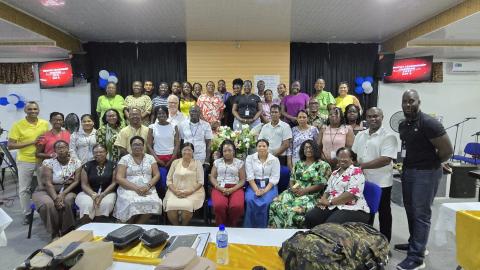
One of the goals that week in Guyana focused on helping Pastor Gregory Ram and his wife strengthen the work of a new church plant, Restoration Community Church in Georgetown. But the impact quickly expanded beyond one church plant. Alongside Gregory and his wife, leaders from 7 additional churches gathered for the first course of Timothy Leadership Training, “Caring for God’s People.” By the end of the training, 57 participants had worked through the material together.
The strength of TLT is not simply in delivering content. Its strength is in combining biblical training with immediate local application. Every participant develops an Action Plan connected directly to their ministry context. Rather than leaving with abstract ideas, leaders leave with concrete next steps for discipleship, evangelism, pastoral care, and leadership development within their own churches and communities.
In Guyana (South America) and Classis Quinte (Southern Ontario, Canada), that approach has proved remarkably effective. While each participant developed a personal Action Plan, churches also worked together to create shared ministry plans. Around the tables, leaders discussed how to care for people more effectively, strengthen discipleship, and develop healthier churches. The conversations were practical, hopeful, and deeply rooted in local ministry realities.
One woman involved in church leadership came to the front during the training and shared how meaningful the Action Plan process had become for her. She explained that she regularly used strategic planning and action plans in her workplace, but had never considered applying those same principles within church ministry. She told the group, “I love strategic planning, and I’m so grateful you brought this idea to us for our church ministry.” Her comment reflected something many participants were discovering throughout the week: practical leadership development can become a powerful tool for strengthening local churches and supporting long-term ministry health.
One of the encouraging features of the week in Guyana was the strong participation of women in leadership development. Many of the churches represented already relied heavily on women serving in discipleship, care ministry, and local outreach. Their engagement strengthened the discussions and brought valuable ministry insight into the room.
The experience in Guyana also highlighted something much larger taking place within the Christian Reformed Church in North America. As the denomination moves toward a developing 10-year vision for church planting, one reality becomes increasingly clear: church planting requires equipped leaders. Healthy churches do not emerge simply because a planter arrives in a community with vision and enthusiasm. Sustainable ministry requires teams of trained and growing leaders within local congregations.
That is where Timothy Leadership Training becomes especially important.
Developing leaders within the church is foundational to preparing future church planters. TLT equips elders, ministry leaders, discipleship leaders, outreach volunteers, and emerging leaders to serve more effectively in their own ministry settings. Strong churches require strong leadership development pathways, and TLT provides one practical way to help build those pathways.
That conviction is shaping leadership development efforts within Classis Quinte as well.
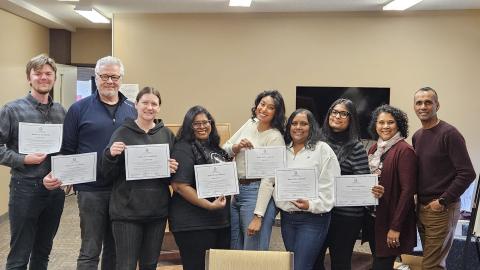
Earlier this year, the first local TLT cohort completed the basic level of training with seven participants. That may seem small compared to the Guyana cohort, but the goal is multiplication, not simply numbers. Pastor Mark Jallim of Living Hope Community Church, Durham, Ontario, is beginning a second cohort in May, and Pastor Martin Spoelstra from Discovery Church in Bowmanville, Ontario, is starting a third cohort in September.
What makes this especially encouraging is the emphasis on implementation and accountability. Participants are expected to apply what they learn directly within their church context and then report back on their Action Plans. Leadership development moves beyond theory into lived ministry practice.
Many churches today are facing significant leadership challenges. Some congregations are aging. Others are struggling to identify and equip emerging leaders. Church planting initiatives often face the same issue: new ministry opportunities arise faster than leaders are developed to sustain them.
TLT addresses this challenge in a simple but powerful way. It creates a reproducible leadership development structure rooted in Scripture, practical ministry skills, and accountability. Leaders are encouraged to grow, serve, and multiply leadership within the local church.
What became especially clear in Guyana was that leadership development and mission belong together. The church plant led by Gregory Ram was strengthened because leaders from multiple churches were being equipped simultaneously. The local church became both the place of discipleship and the launching point for broader mission.
That same principle applies in North America. If the CRC is serious about church planting over the next decade, leadership development cannot remain peripheral. Equipping leaders within existing churches is part of preparing the soil for future church plants, ministry renewal, and long-term gospel witness.
A few days after returning home from Guyana, Discovery Church celebrated an infant baptism, an adult baptism by sprinkling, and an adult baptism by full immersion at Discovery Church. Different stories. Different ages. Different journeys of faith.
Yet those baptisms and that breakfast conversation in Guyana pointed to the same reality: leadership development, discipleship, and church planting are ultimately about seeing people encounter Jesus Christ and helping local churches become places where faith is nurtured, leaders are equipped, and the gospel continues to spread from one generation to the next.

Comments
Thank you for sharing this, Dr. Spoelstra! It's great to see how church plants are growing and thriving, both in North America and around the world. It's also great to see how there is an excellent, functional model for developing and supporting new and emerging leaders.
Let's Discuss
We love your comments! Thank you for helping us uphold the Community Guidelines to make this an encouraging and respectful community for everyone.