
There were many healthy discussions that took place during Synod 2026. I find it encouraging that the CRC seems to be feeling very introspective at the moment.
In many ways, we now know a bit more about who were "are not". This is good. (In fact some philosophers contend that identity itself is primarily discovered by establishing what a thing is not.)
Yet Christians should also be happy and confident to declare who they are. Because the Triune God stands at the back of Creation and reveals Himself throughout His Creation and more clearly in His Word, we can and should embrace positive statements and a positive identity in Christ.
One such introspective conversation took place around the denomination's understanding of our core principles of worship. With worship, as with identity, it is worth our time to think about both what we should (positively) be doing in worship, and what we should not be doing in worship (negatively).
What are the things that God wants us to do when we worship Him? Are there ways of "worshiping" God that He actually dislikes? Or can we worship God in any way, so long as our heart is in the right place?
Unsurprisingly, different Christians have come to different conclusions in answer to these questions. Even within "Calvinistic" groups, there has been discussion and debate. But, in conjunction with the common emphasis in Reformed Theology on the primacy of God's Word, "Reformed" denominations have traditionally come to a general consensus, which is:
God's Word is the standard and source of our worship principles.
Therefore, we may not worship God through any acts that are forbidden. By this we mean that we may not worship God through sinful actions. (We may not steal or lie as an act of worship. Nor may we worship through idolatry or false gods.) On the other hand, we must worship God in ways that God prescribes. Looking in the New Testament, we find the reading of Scripture and the teaching of the meaning and fullness of it. We are commanded to administer the Lord's Supper and Baptism. We find commands to gather together, to sing, to pray, and to give our offerings.
Many of the specifics of these elements have been debated (May we use instruments to aid us in singing? May we sing hymns along with psalms?), and some Reformed denominations have voiced different answers to those debates, but the elements themselves have been consistent, not just for Reformed churches, but for much of church history.
In fact, one of my favorite classes at Calvin Theological Seminary, "Forming Worshiping Communities", went to great lengths to show the continuity of Reformed liturgies, especially from John Calvin's Geneva until the modern day. The Reformation famously threw off many of the add-ons that had developed in Roman Catholic or Eastern Orthodox liturgies over the centuries, but kept those elements which bore their origin in New Testament apostolic authority.
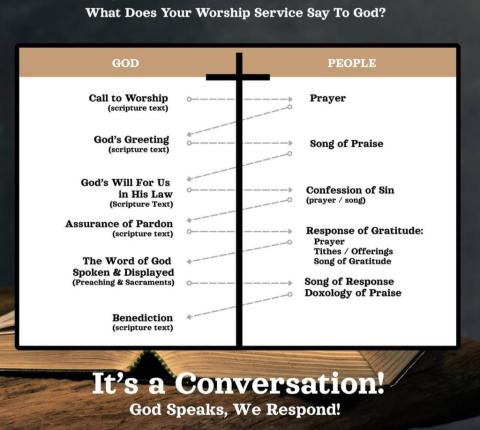
While scrolling online a couple days ago, I stumbled upon this graphic (attached to the bottom of this post). I found it to be such a perfect example of a traditional CRCNA liturgy.
For a long time before my ordination, with a license to exhort, I had the privilege to "exhort" at numerous different CRC churches throughout the midwest. I found that the older a church was, the more likely it was to stick closely to this traditional template. Indeed, some newer churches will sometimes model more closely toward generic evangelical churches than a standard CRC church used to, but many churches still worship with this traditional liturgy.
Here is a text-based copy. The order can sometimes vary a bit:
Welcome & Announcements
[God Calls Us To Worship]
*Call to Worship (scripture passage, often call and response)
*Opening Prayer
*Song of Praise
*God's Greeting
*Mutual Greeting
[We Respond with Confession]
Call to Confession (scripture passage, often call and response)
Prayer of Confession
[God's Forgiveness]
Assurance of Pardon (scripture passage, often call and response)
Song of Gratitude
[We Speak to God]
Guide for Grateful Living (scripture passage, often call and response)
Congregational Prayer
[God Gives Us His Word]
*Song of Preparation
Prayer of Invocation
Scripture passage
Sermon
Prayer of Application
The Lord's Supper
[We Respond With Praise]
*Song of Response
Offering
[God Sends Us Out Blessed and To Serve]
*Blessing
*Closing Song
---
I'm curious: How closely does your church match this outline? What have you seen added or subtracted to this?
What is definitive about a CRC liturgy? What is universal to all churches?

Comments
Great post Trevor! Thank you for sharing! Looks like our own pattern at Ada CRC follows this fairly closely. As a newcomer to the denomination over the last 4 years, I'm encouraged that as a whole, we share much unity in our worship with our Reformation brothers and sisters in a vareity of churches. While each denomination may have it's own distinctives, this "shape" of worship, following a conversational pattern and moving through a "gospel" focused covenant meeting with God is something that is fairly well adopted among the various Reformation heritage churches.
Those among us who emphasize our unity (and a growing need for unity) ought to take comfort and delight in seeing that despite many differences on a host of issues, worship is a growing point of interpretative unity.
Hi Trevor,
Thanks for reflection. In answer to your question, my church follows this order of worship fairly closely. Our "mutual greeting" time is kept outside of the order of worship after announcements and before the official call to worship. Our offering is taken earlier in the service than listed here. Also, as with many, we do not have weekly celebration of the Lord's Supper.
You may want to make a correction. You say: "we must worship God in ways that God proscribes". I am sure that you mean "prescribes". (proscribe: to condemn or forbid as harmful or unlawful)
I've been to a number of large evangelical churches as I've visited different places, and I am always struck at the rootlessness of their liturgy, which really consists mainly of welcome, 3-4 song set, announcements, Word, dismissal. The dialogic nature of Reformed worship is sweet and renewing - they are missing out.
Thank you, Eric! I definitely meant "prescribe"! To go along with the typo would have led to the exact opposite of what we're saying!
I'll try to edit the article.
My church also does not practice the Lord's Supper every week (although I'm sympathetic to the practice). But I thought it should be included in a hypothetical template.
I love this discussion, Trevor, thank you!
Our congregation generally follows this liturgical format with varying levels of formality. Some portions, like the Call to Worship, are quite consistently formal and responsive. Other portions, like how we deal with Confession/Assurance varies on Lord's Day to Lord's Day, (some Sunday's confession is included in the Pastoral Prayer, others it is a formalized liturgy with a reading of the Law).
I have found it interesting, in reading through the liturgies of the Reformation in Gibson and Earngey's, Reformation Worship, (https://reformationworship.com/liturgies/) how the liturgies in the Reformation period and beyond were definitely dialogical, but also structured a little differently, often they began with Confession, Assurance, and a reading of the Law before going anywhere else in a service of worship. I do wonder if there are some other ways to think about how to have dialogical worship services, founded on Scripture, and perhaps change our perception of what we're doing when we gather together. (Beginning with confession perhaps displays to us the right perception of the holiness of God!)
I am curious if there are any interesting discussions that might come from this--forgive me if some of this might be a little stream-of-consciousness!
Hi Tim. When you say "beginning with confession" do you mean to say that confession might be before even the call to worship? It seems like the liturgy laid out above does have confession very near the beginning, so I'm curious about the idea of moving it even earlier. Where, exactly, might you slot it instead of where it sits above?
I do like how confession and assurance early in the service set our perspective of God, our place before God as sinful yet forgiven creatures, his welcome based on Christ's work, and our anticipation of Christ being further revealed and praised throughout the service. I do find that general order above accomplishes that, but I'm interested to hear more about how it might fit to move that even earlier.
Hi Eric. Not that this is something we'd have to do, but for example, here's Calvin's Form of Ecclesiastical Prayers,
(1545, 1542, 1566) from Geneva, (specifically formulated for a Service of the Word):
SERVICE OF THE WORD
Votum (Ps. 124:8)
Confession
Prayer for Forgiveness
Psalm
Prayer for Illumination
Scripture
Sermon
Intercessions
Lord’s Prayer Paraphrase
Benediction
Worship began with the Votum, and then jumped right into confession of sin, all well before Psalm-singing, and functions as a Call to Worship as you said.. Not that there is anything wrong with worship beginning with a Call to Worship and Opening Prayer, it is perfectly fine to do so, but I wonder out loud if there is anything to be gained (or lost) by this more traditional approach. If we have questions of how to define distinctly Christian Reformed worship services, this certainly contrasts with broader Evangelicalism, as well as with many Reformed and Presbyterian practices.
Again, I am not suggesting this is something we should do, I have certainly been edified in classic CRC worship services, as well as standard broader Evangelical worship services, but perhaps food for thought!
Interesting. Thanks for thinking together.
For some reason it feels quite abrupt to me to have confession placed there. That is likely due to a lifetime of confession being early in the order, but not that early. The more traditional CRC liturgy allows us to begin with a bit of welcome/greeting/introduction that sets the stage (for me) for confession. I think this allows our hearts to "settle in" a bit before confession and assurance, perhaps allowing our time of confession be a bit more contemplated and purposeful as opposed to the abruptness of immediate confession. When we hear the call to worship and God's greeting we respond in prayer and praise it seems to me that this introductory dialogue re-introduces the dialogic partners and sets the stage for confession because we are ushered in and have already begun to acknowledge our dependence and God's worthiness of praise.
Anyway, it's interesting to think through these things and I think just the act of discussing the various elements and their order helps us be purposeful and engaged in our worship, no matter how we might tinker (or not) with the particular order.
I think you're right, it does feel abrupt. For Reformation Sunday Evening Service a couple years ago, we tried to open worship with Confession, and found that yes, indeed, it felt abrupt, but also, the change in what is sometimes ritual was very meaningful to a number of people. Then again, we haven't done it since.
I do believe it's helpful for us to think intently on how worship services can primarily best glorify God, and secondarily best edify His people, and I think these conversations can play into that, thanks for thinking with me.
Let's Discuss
We love your comments! Thank you for helping us uphold the Community Guidelines to make this an encouraging and respectful community for everyone.